Ball
The international rules specify that the game is played with a light 2.7 gram, 40 mm diameter ball. Generally, it is the most-used ball. The rules say that the ball shall bounce up 23 cm when dropped from a height of 30 cm thereby having a coefficient of restitution of 0.88. The 40 mm ball was introduced after the 2000 Olympic Games. However, this created some controversy as the Chinese National Team argued that this was merely to give non-Chinese players a better chance of winning[citation needed]. A 40 mm table tennis ball is slower and spins less than a 38 mm one. The ball is made of a high-bouncing gas-filled celluloid, colored white or orange, with a matte finish. The choice of ball color is made according to the table color and its surroundings. For example, a white ball is easier to see on a green or blue table than it is on a grey table. Stars on the ball indicate the quality of the ball. 3 stars indicates that it is of the highest quality, and is used in official competitions.
- The volume is
 mm cubed.
 - The Surface area is 1600π mm squared.
- The perimeter is 40π mm.
Table

The table is 2.74 m (9 ft) long, 1.525 m (5 ft) wide, and 76 cm (30 inch) high with a Masonite (a type of hardboard) or similarly manufactured timber, layered with a smooth, low-friction coating. The table or playing surface is divided into two halves by a 15.25 cm (6 inch) high net.[6] The table surface is often in a green or blue color.
Racket
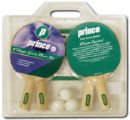
Players are equipped with a laminated wooden racket covered with rubber on one or two sides depending on the grip of the player. This is called either a paddle, racket, blade or a bat depending on where in the world the game is being played. In the USA the term "paddle" is common, in Europe the term is "bat," and the official ITTF term is "racket."
Table tennis regulations allow different surfaces on each side of the racket. The different types of surfaces provide various levels of spin or speed, or in some cases, nullify spin. For example, a player may have a rubber that provides much spin on one side of his racket, and no spin on the other side of the racket. By flipping the racket in play, different types of returns are possible. To help a player distinguish between different types of rubber used by his opposing player, international rules specify that one side must be red while the other side must be black. The player has the right to inspect his opponent's racket before a match to see the type of rubber used and what color it is. Despite high speed play and rapid exchanges, a player can see clearly what side of the racket was used to hit the ball. Current rules state that, unless damaged in play, the racket cannot be exchanged for another racket at any time during a match.